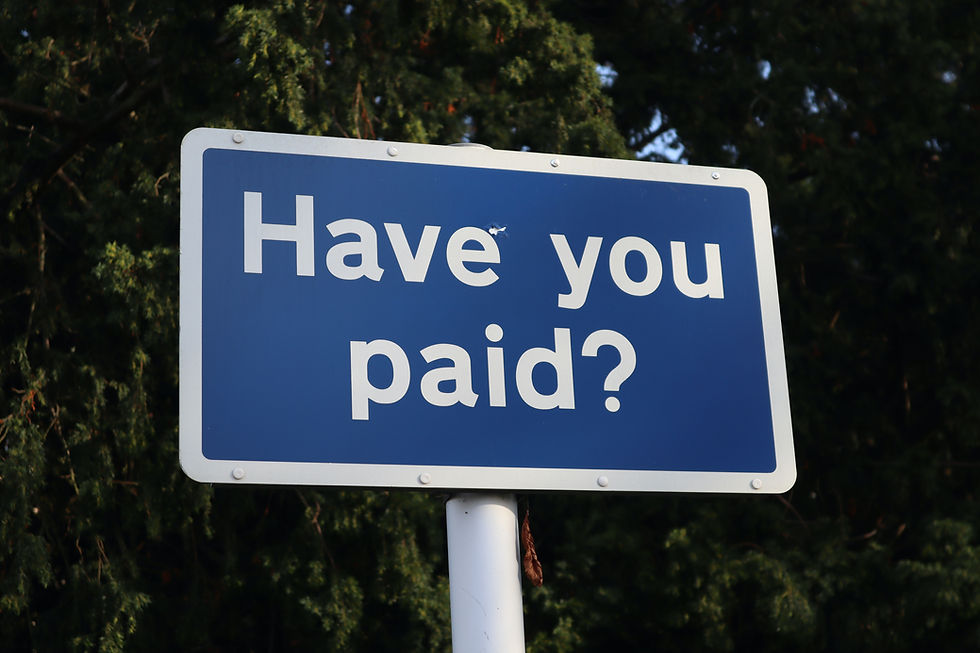
When a Customer Doesn't Pay: What Can Your Business Actually Do?

An invoice was due two weeks ago.
You've sent a reminder. You've emailed your usual contact. You've been told that "accounts are looking into it".
Still nothing.
So what happens next?
The appropriate response will depend on the contract, the amount involved and the circumstances, but businesses generally have several options before or alongside formal legal proceedings.
Start with the contract
Before taking action, check what you actually agreed.
Look at the payment date, any provisions dealing with disputed invoices, interest, suspension, termination and the process for providing formal notices.
The contract may give you rights that aren't immediately obvious from looking at the unpaid invoice alone.
Communicate clearly
Sometimes invoices are unpaid because of relatively straightforward administrative problems.
A clear written reminder confirming the invoice number, amount, due date and payment details can resolve the issue without escalation.
If the customer says the invoice is disputed, ask them to explain exactly what is being challenged.
This can help distinguish a genuine commercial disagreement from a general delay in payment.
Consider interest and recovery costs
Businesses may have statutory rights relating to late commercial payments.
Subject to the relevant requirements, a supplier can potentially claim interest and a fixed sum towards the cost of recovering an overdue commercial debt.
Your contract may also contain its own provisions dealing with interest and recovery.
Consider whether continuing to supply makes commercial sense
If invoices continue to accumulate, so does your exposure.
Depending on your contractual rights, it may be possible to suspend further work or supplies until overdue amounts are paid.
However, don't simply stop providing contracted services without checking your legal position first. Doing so incorrectly could potentially put your own business in breach.
Escalate when necessary
Where informal attempts have failed, the next stage might involve a formal letter demanding payment or the use of a debt recovery process.
Ultimately, court proceedings may be an option, although the cost, time and commercial relationship should all be considered.
The objective isn't necessarily to pursue the most aggressive option available. It is to choose an approach that is proportionate to the debt and protects the business's position.
Deal with the problem before it becomes a problem
Debt recovery starts long before an invoice becomes overdue.
Clear payment terms, effective credit control and well-drafted contractual rights can make dealing with non-payment significantly easier.
If you're repeatedly experiencing payment issues, it may be worth reviewing the underlying contracts rather than simply improving the way overdue invoices are chased.
Lawpoint can help with commercial contracts, payment provisions and disputes, giving your business a clearer position when customers don't pay as agreed.